
When your audiologist recommends hearing aids for treating your hearing loss, you’ll be faced with a number of choices: style, size, extra features, accessories, budget…and battery type. At Premier Medical Group, we see ourselves as your partner and advisor on decisions like these, and we want to help you get the hearing aid that works best for your hearing needs and lifestyle. So, let’s break down one of those decisions together and talk about the differences between rechargeable hearing aids and rechargeable “button” batteries.
Which Battery Type Is Better?
Approximately 30 million people in the U.S. need hearing aids,1 and everyone has different needs. For example, someone with profound hearing loss who travels frequently will have vastly different hearing aid needs than a person with mild hearing loss who lives a more reserved life close to home. Because of this, there is no “right” answer to which battery type is better; it will come down to your hearing loss needs and your lifestyle.
Rechargeable Batteries
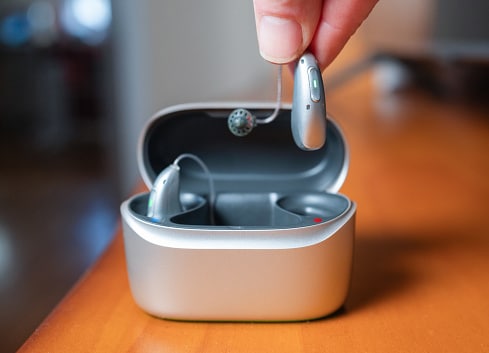
Hearing aids with rechargeable batteries are docked on a charger, like your phone. You’ll never need to remove the battery and replace it. A full charge typically lasts about a day, so daily charging is required, but rechargeable hearing aids can be recharged hundreds of times, meaning they should last a couple of years.
Pros of Rechargeable Batteries
Rechargeable batteries may be a good fit for you if:
- You have a reliable schedule. Your hearing aids need to be charged daily, so you need to know that you’ll have the time and access to electricity to charge them. Most people charge them overnight.
- You want a longer lifespan. Rechargeable batteries usually last about five years before they need to be replaced, but you’ll recharge them hundreds of times in that time.
- You want less clutter. No need to purchase, store and carry extra hearing aid batteries all the time.
- You want to keep batteries out of the landfill. Rechargeable batteries are the more environmentally friendly option.
Cons of Rechargeable Batteries
Rechargeable batteries may not be a good fit for you if:
- You have an inconsistent schedule or don’t have reliable access to power. You need to get to a power source every day to charge. They also take a few hours to charge, so if your hearing aids die in the middle of the day, you don’t have a quick fix; your devices are down and out until you can charge them.
- You’re a child (or the caretaker of a child who wears hearing aids). Kids often forget to charge their hearing aids overnight, leaving them with a dead battery the next morning. Longer-lasting button batteries that can be changed on the fly are easier for them.
Budget is also a consideration. In general, rechargeable hearing aids are more expensive up-front than button battery-powered hearing aids (of course, the exact cost can vary depending on style, brand, technology and other variables). That said, despite the higher up-front cost, you won’t need to continually purchase batteries, so they are more cost-effective over time.
Button Batteries
Up until a few years ago, all hearing aids used button batteries (so named for their shape and size), so these are a more common option. These small, round batteries last a few days, then you remove them and replace them whenever they run out of charge.
Pros of Button Batteries
Button batteries may be a good fit for you if:
- You’re on-the-go a lot. You can go a long time on a set of batteries and replace them anywhere, so long as you have a pack on hand (batteries are widely available and easy to find).
- You don’t want to charge every day. Button batteries can last anywhere from a few days to a week, meaning you can set them and forget them for days at a time.
- You like to troubleshoot issues on your own. A busted rechargeable battery means a trip to the clinic to get it looked at; when a button battery has issues, you can just replace it.
- You’re a child (see above).
Cons of Button Batteries
Button batteries may not be a good fit for you if:
- You have dexterity issues. These batteries are small, and the door to open the battery compartment on your hearing aids is delicate. It’s easy to fumble or drop the batteries, especially if you have dexterity issues.
- You lose things easily. Being able to change your hearing aid batteries on the fly is a great benefit, but only if you have a spare pack on hand. It’s imperative to grab a battery pack at the store or pharmacy when you’re running low, and to keep one with you wherever you go.
We’re Here to Help
We know choices like these can be overwhelming to make, especially in the wake of starting a new health program. We’re here to help you make the choice that makes the most sense for you. If you are unsure, don’t hesitate to ask us questions or describe your lifestyle so we can offer our recommendations. Contact Premier Medical Group to learn more.
Learn More
1 National Institute on Deafness and Other Communication Disorders. (2024, September 20). Quick Statistics About Hearing, Balance, & Dizziness. NIDCD. https://www.nidcd.nih.gov/health/statistics/quick-statistics-hearing